Adjustable Dumbbells: Independent Each Hand vs Paired Loading
By Lila Menon • 20th Nov
Quick verdict
Quick verdict: Do not infer simultaneous unequal settings—or required matching settings—from the fact that the two sets compared here are listed as pairs.
- Choose the first option if: You want a compact pair for routines that normally use the same weight in both hands. Compare the adjustment workflow and fit rather than assuming either set supports simultaneous unequal settings.
- Choose the alternative if: Different left/right weights are central to your training. Require explicit confirmation of simultaneous unequal settings, permitted combinations, and the adjustment sequence before buying.
- Main trade-off: PowerBlock uses a magnetic pin; Core Fitness uses TwistLock adjustment in a cradle. These documented mechanisms describe the changeover process, not whether either system supports simultaneous unequal settings or requires matching settings.
Important: The available evidence comes from retailer listings, not manufacturer manuals or hands-on testing.
Adjustable dumbbells can make a small home training space feel wonderfully workable, but a listing that describes a set as a pair and the ability to use different weights in each hand are not the same product feature. If you are comparing adjustable weight dumbbells for a quiet apartment routine, the useful question is not simply, Do I get two dumbbells? It is: can I verify how each dumbbell selects its load, and does that workflow support the way I actually train?
That distinction matters when your session happens before work, after a child is asleep, or in a room shared with people who did not volunteer for a clanking strength program. A neutral wrist and a quiet nervous system make control easier to repeat. And repeatability, not a complicated gear story, is what turns a corner of your home into a training practice.
The short answer: do not assume a pair tells you the relationship between settings
Two questions are often blurred together:
- Simultaneous unequal settings: Can the two dumbbells remain at different selected weights at the same time?
- Required matching settings: Does the system require both dumbbells to use the same selected weight?
Both sets compared here are listed as pairs, but that wording does not answer either question. In these listings, “pair” states how each set is sold, while “per hand” on PowerBlock and “each” on Core Fitness describe the stated range for an individual dumbbell. None of those terms proves whether the two can be set to unequal weights simultaneously, nor does it prove that they must match.
That is the key buying rule: treat simultaneous unequal settings as a feature that needs explicit confirmation in the current manual, product support materials, or seller documentation. Do not fill in the missing information from product photos, a reviewer's routine, or the fact that there are two cradles.
Comfort that keeps you consistent is performance in disguise.
For any home lifter, the relevant question is whether the documented configuration matches the loads planned for a session. If you deliberately want different weights in each hand, look for clear confirmation that the product supports that arrangement.
Why this question is more nuanced than it sounds
"Per hand" describes the PowerBlock range, not the relationship
For the PowerBlock Pro 50, the listing says the set ranges from 5 to 50 pounds per hand. That establishes an individual-dumbbell range. It does not explain the relationship between the left and right settings.
That wording can still be useful. It tells you the practical range available to each hand. But if your purchase decision depends on lifting with different weights in each hand, ask a more specific question:
"Can both dumbbells be set to different selected weights at the same time, using the included components?"
Ask it in writing when possible, and keep the answer with your order information. This is especially worthwhile with custom dumbbell sets and fast-adjust systems, where the changing mechanism is a meaningful part of the purchase.
The mechanism affects the rhythm of your session
The adjustment method does not automatically tell you whether unequal settings are supported. It does, however, tell you what you will physically do between sets.
A calm changeover is body-friendly. Set the dumbbell fully into its cradle or selector position, let your shoulders soften, make the adjustment deliberately, and then check the chosen setting before you lift. That tiny pause is not wasted time. It can prevent the rushed grip squeeze and wrist bend that show up when you try to beat the clock.
I learned to respect this after an elbow kept flaring during sessions with a rattly handle. Filming my wrists made the pattern obvious: the more I anticipated movement in the gear, the harder I gripped and the less neutral my wrist became. A slightly thicker, well-cut handle changed the tone of the session more than another aggressive set ever did.
What the documented product details do, and do not, tell us
PowerBlock Pro 50: pin-based adjustment
The retailer listing for the PowerBlock Pro 50 Adjustable Dumbbells describes a pair with a stated range of 5 to 50 pounds per hand. It describes adjustment with a secure magnetic polypropylene pin. The listed dimensions are 12.5 inches long by 7 inches wide by 7.25 inches high.
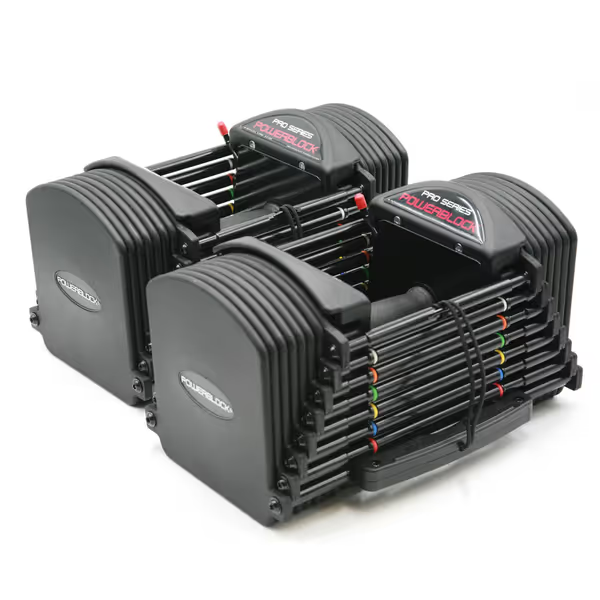
POWERBLOCK Pro 50 Adjustable Dumbbells
Quiet, compact, and quick-adjust for small-space, neighbor-friendly lifting.
$466.65
Replaces16 pairs (825 lbs) of free weights
Replaces16 pairs (825 lbs) of free weights
Pros
Fast, secure magnetic pin weight changes
Durable steel build with 5-year warranty
Compact footprint (12.5" L x 7" W x 7.25" H)
Cons
Cannot expand past 50 lbs
Shape may limit some exercises
Customers praise the build quality, easy weight changes, and durability, considering them good value.
Customers praise the build quality, easy weight changes, and durability, considering them good value.
Those details make the selection workflow clear at a basic level: use the pin to choose the load for an individual dumbbell. They do not establish whether both dumbbells can be set to different weights at the same time. If simultaneous unequal settings are essential to your program, verify that point directly before purchasing.
The listed dimensions are helpful for one practical planning task: measure the shelf, floor corner, or cabinet opening where you intend to keep the dumbbells. Add room for your fingers to retrieve and return them without scraping walls or furniture. But do not treat one product's dimensions as proof that it will store better than another product with no comparable dimensions published.
Core Fitness: cradle-and-twist adjustment
The retailer listing for the Core Fitness Adjustable Dumbbell Weight Set also describes a pair with a stated range of 5 to 50 pounds each. Its listed process is to place a dumbbell in its cradle and twist the handle; the listing says the setting can be changed with one hand and identifies the mechanism as TwistLock technology.
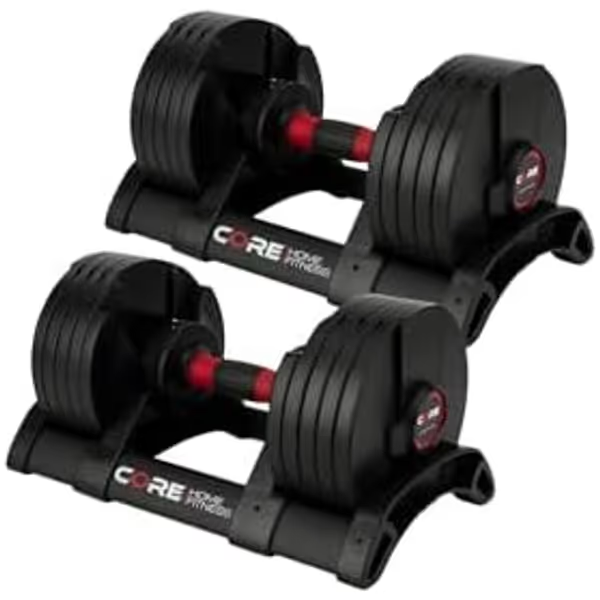
Core Fitness Adjustable Dumbbells
Quiet, compact, and quick 5-50 lb weight changes with one hand.
Weight Range5-50 lbs per dumbbell
Weight Range5-50 lbs per dumbbell
Pros
TwistLock for fast, one-hand weight changes
Compact design fits small spaces easily
Contoured, textured grip for comfort
Cons
Plastic components may raise durability concerns
Again, this describes the adjustment of a single dumbbell, not the relationship between both dumbbells' settings. It would be inaccurate to say this listing confirms simultaneous unequal settings. It would be equally inaccurate to say it requires matching settings.
The listing also states a two-year parts warranty. Warranty terms can change and may include conditions, so read the manufacturer's current terms rather than making a decision from a headline duration alone.
Which loading approach fits your real training day?
Choose settings that match your planned session
If you are shopping for adjustable dumbbells to replace multiple fixed-weight pairs, keep the decision clean:
- Consider whether you expect your work to use the same load in both hands.
- Consider how many decisions you want to make during a short session.
- Compare the documented adjustment sequence with the configurations your training requires.
- If you train during quiet hours, plan slow, intentional transitions rather than hurried adjustments.
Your training notes can stay simple: record the selected load, repetitions, and how controlled the movement felt. If the grip was tense, the handle rattled, or your wrist had to work to find center, that information is useful too.
Seek verification when unequal loading is intentional
Different weights in each hand are a specific configuration. Consider it only if you have a clear reason to use it and can get a clear answer about the equipment.
Before buying, make a short verification list:
- Simultaneous settings: Can the left and right dumbbells remain at different weights at the same time?
- Full range at unequal settings: Are there any restrictions on which combinations can be selected?
- Change sequence: Must both dumbbells return to their cradles before one can be adjusted?
- Lock check: What does the maker instruct you to check before lifting after a change?
- Return and support: If the mechanism does not suit your hands or space, what is the current return process and parts policy?
A seller who cannot answer the first question clearly has not given you enough information to buy specifically for simultaneous unequal settings.
How to evaluate the system in your home, not a showroom
Start with the quiet-hours test
No listing detail can tell you how your specific building will respond during a workout. Rather than planning a loud test session, do a conservative setup check after the dumbbells arrive:
- Put the cradles on the exact surface you will use.
- Practice placing each dumbbell down with both hands, rather than dropping or catching it late.
- Listen for contact between components as you change selections.
- Notice whether you brace your hand in anticipation of rattle or shifting.
- Keep maximal-effort work for a time and place where noise is not a concern.
Focus on gentler placement, deliberate adjustments, and a layout that does not force you to carry a loaded dumbbell across a hard floor.
Use a 60-second fit check for your hands
Before your first full workout, hold each dumbbell at a light setting and scan three points:
- Wrist: Can you keep the wrist stacked rather than bent toward the thumb or little-finger side?
- Grip: Can your fingers close without a white-knuckle squeeze?
- Shoulder: Can you let the shoulder sit down rather than hike toward your ear?
Then rehearse a few slow, unloaded-feeling patterns: a curl, a press path without forcing depth, and a hip-hinge row position. You are not testing toughness. You are checking whether the handle geometry encourages a neutral wrist and quiet nervous system.
If the answer is no, pausing the session is sensible. Gear should reduce friction, not ask your joints to negotiate with it every time you train.
FAQ: dumbbell settings and adjustment
Can a pair of adjustable dumbbells be assumed to use matching weights?
No. For the two products compared here, the listings say they are sold as pairs, confirming that each listed set includes two dumbbells. That wording does not establish whether matching settings are required.
Can I assume adjustable dumbbells allow different weights in each hand?
No. In the listings compared here, “per hand” and “each” describe the range for an individual dumbbell, not whether the two dumbbells may hold different selected weights simultaneously. Look for an explicit statement from the maker or seller.
Is a fast adjustment mechanism automatically better for supersets?
No reliable setup-time comparison was established for these products. Compare the documented adjustment steps with your own routine rather than assuming one mechanism will be faster for supersets.
What should I check first if I train around sleeping people?
Check how the dumbbells sit in their cradles, how quietly you can return them, and whether you can adjust them without fumbling. Build your routine around controlled placement and a predictable storage spot.
Explore the decision one step further
The honest comparison is not "independent is advanced, paired is basic." It is documented capability versus assumed capability. For many home routines, a pair with an adjustment process you trust will be exactly right. If your plan truly depends on different weights in each hand, make that one feature non-negotiable, and get it confirmed before the boxes arrive.
From there, explore the details that your body and household will notice every session: handle comfort, stable selection, a clear return path to the cradle, measured storage space, and a gentle warm-up before loading heavier. The right adjustable dumbbells should make training feel quieter, steadier, and easier to return to tomorrow.
Related Articles