Dumbbells vs Kettlebells for Small Home Gyms: Data-Driven Pick
By Rowan Takahashi • 23rd Aug
Quick verdict
For most small home gyms, choose adjustable dumbbells for broader exercise variety, paired loading, finer progression, and higher available top-end weights.
- Choose dumbbells if: You need two independently loaded hands, smaller weight changes, or up to 52.5–60 lb per dumbbell in the examples reviewed.
- Choose a kettlebell if: You consistently train with a kettlebell format and value a single central handle over paired handles.
- Main trade-off: The listed pound-based models differ in settings and range: the Bowflex 840 has six settings from 8–40 lb, while the Results Series 552 has 15 settings from 5–52.5 lb per dumbbell; the REP 20–40 lb kettlebell has five settings, while QuickDraw configurations reach up to 60 lb per dumbbell.
Important: The evidence reviewed here does not establish that either tool is universally better for strength, muscle gain, conditioning, mobility, or fat loss.
The useful answer to dumbbells vs kettlebells is not that one is universally better. In a small home gym, the better pick is the tool whose loading range, shape, adjustment steps, and storage dimensions match the work you will repeat, without turning a late workout into a noise problem. For most people seeking the best home adjustable dumbbells, adjustable dumbbells are the more flexible single purchase. An adjustable kettlebell is the cleaner first purchase when your training is built around kettlebell-specific movements and you want a single central handle.
That is a decision about constraints, not hype. The evidence reviewed here does not support claims that either tool categorically wins for strength, conditioning, fat loss, mobility, or muscle building.
Quiet strength is measured, not guessed, set after set.
The short decision matrix
| If your priority is… | Better first pick | Why the available product data points that way |
|---|---|---|
| Broad exercise variety with two independently loaded hands | Adjustable dumbbells | REP QuickDraw and Bowflex Results Series 552 dumbbells are sold as pairs; the 552 includes 2.5-lb steps, while QuickDraw uses standard 5-lb increments with a conditional 2.5-lb option |
| One adjustable tool for kettlebell-specific work | Adjustable kettlebell | The REP adjustable kettlebell provides five selectable loads in one body |
| Smaller load changes | Adjustable dumbbells | Available examples include 2.5-lb or 5-lb progressions |
| Higher available top-end load in this comparison | Adjustable dumbbells | The listed pairs reach 52.5 lb or 60 lb per dumbbell |
| A compact, upright storage profile | Adjustable kettlebell | The listed Bowflex model measures 8.8 × 7 × 12.5 inches |
Noise still matters in apartments. An adjustment mechanism can be fast and still create a sharp click. Those are separate variables. I logged changeovers at midnight in a thin-walled walk-up years ago, while trying not to wake a neighbor’s baby, and it permanently changed what I ask of home strength equipment: measure the handling, not the marketing.
What changes when you choose a dumbbell instead of a kettlebell?
Dumbbells: the wider loading system
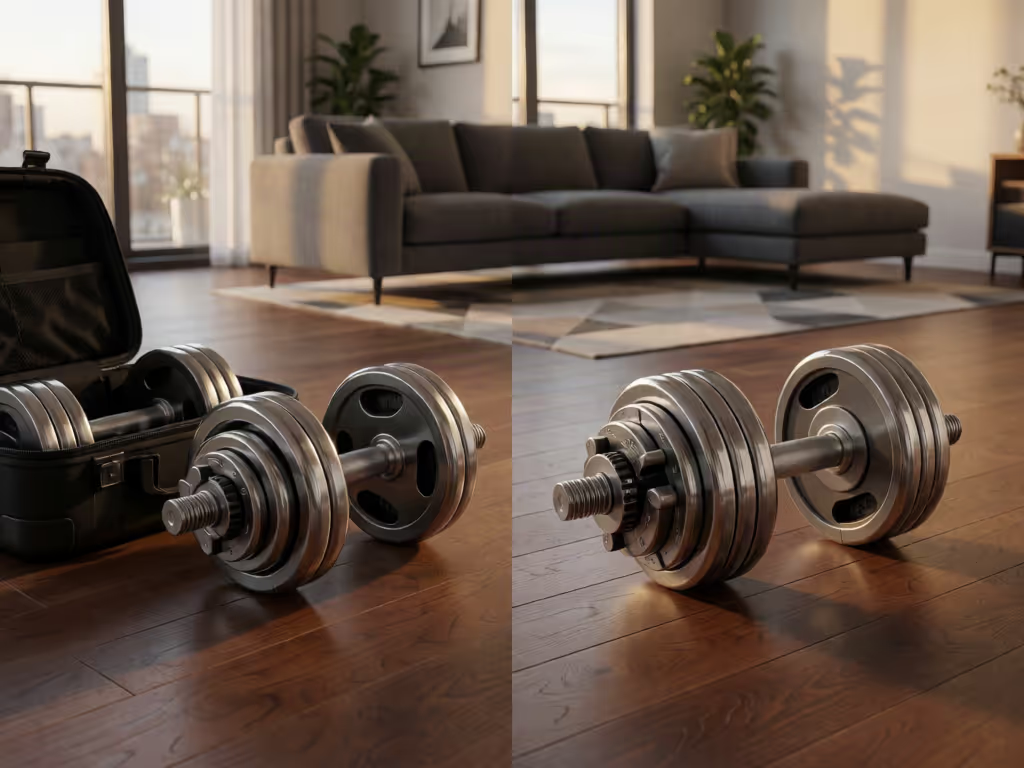
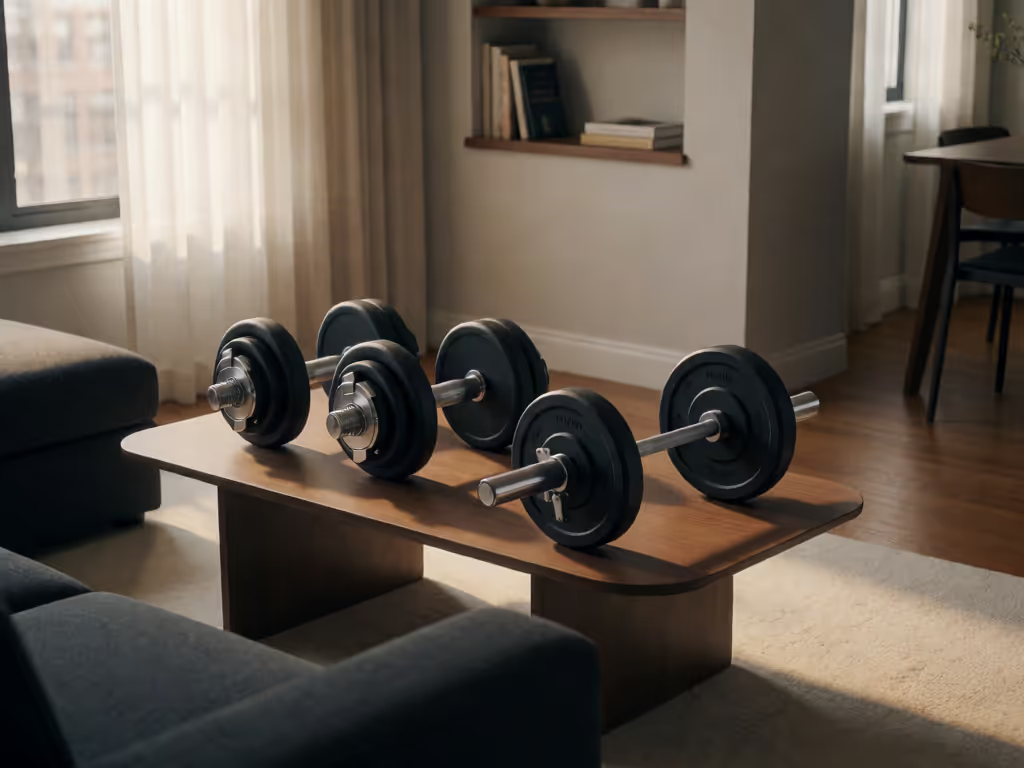
A pair of dumbbells gives you two independently loaded implements. That is the practical advantage for presses, rows, curls, and other movements where a matched pair is useful. Dumbbells also make it easier to keep a training area centered and controlled: lift, return each implement to its cradle or designated spot, then change loads.
The adjustment data is also favorable when weight range and progression detail matter. REP Fitness QuickDraw adjustable dumbbells are sold as pairs in 5–30, 5–40, 5–50, and 5–60 lb-per-dumbbell options. They use Lock-N-Load steel switches. REP states that you can flip one or multiple switches for changes; the system supports 5-lb increments and 2.5-lb adjustments with one micro-adjustment plate, although REP cautions that using one such plate creates a small imbalance.
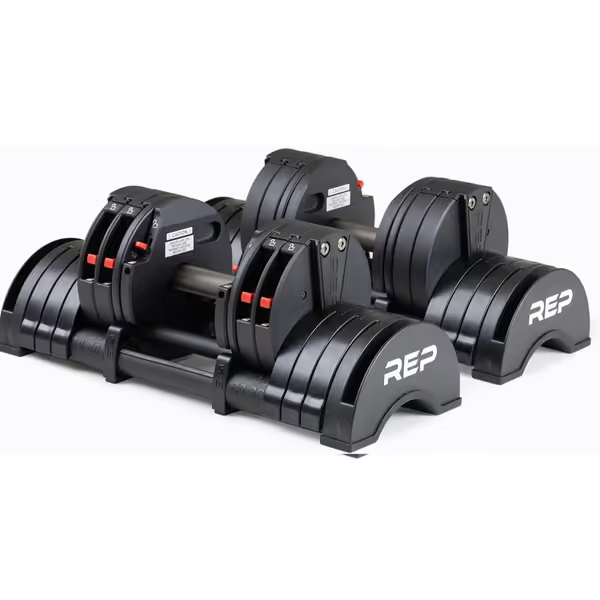
REP Fitness QuickDraw Adjustable Dumbbell Set
Fast, quiet, space-saving weights for focused home workouts.
$335.99
Weight Change SpeedSeconds with Lock-N-Load Switch
Weight Change SpeedSeconds with Lock-N-Load Switch
Pros
Rapid, secure weight changes without fragile gearing.
Replaces 12 pairs of dumbbells, saving significant space.
All-steel build with pro-style knurled grip for durability and feel.
Cons
Numbers on rack can be difficult to read.
Some plate movement reported by a reviewer.
Customers praise quick adjustment, space-saving design, and good quality.
Customers praise quick adjustment, space-saving design, and good quality.
That range is the key point, not a blanket endorsement. A fully expanded QuickDraw reaches 60 lb per dumbbell, while its maximum dumbbell length is 18.5 inches. Its cradle measures 20.6 inches long by 8.45 inches wide, with a listed height of 4.7 inches empty and 7.9 inches with a dumbbell. Measure the storage location with the dumbbells in their cradles, not just the dumbbell body.
For a different adjustment profile, the Bowflex Results Series 552 SelectTech Dumbbells are sold as a pair with 15 settings per dumbbell: 5, 7.5, 10, 12.5, 15, 17.5, 20, 22.5, 25, 30, 35, 40, 45, 50, and 52.5 lb. Each dumbbell is listed at 16.9 × 8.3 × 9 inches and uses quick-adjustment selection dials with a locking mechanism.
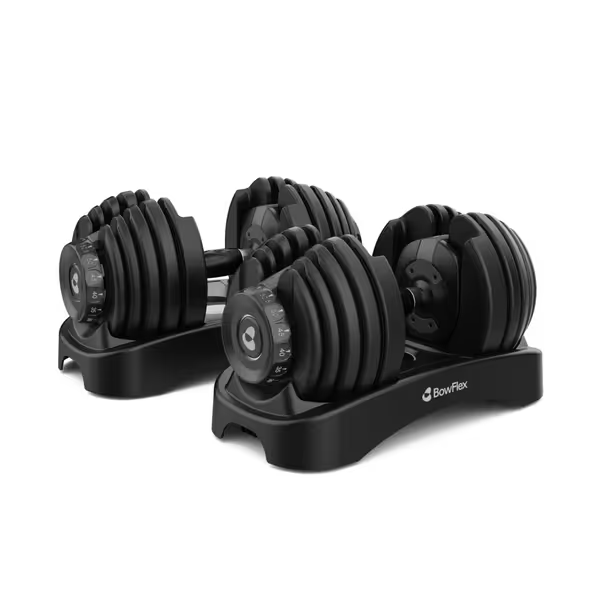
Bowflex SelectTech Dumbbells
Quiet, space-saving adjustable dumbbells for efficient home strength training.
$399
Weight Range5-52.5 lbs per dumbbell
Weight Range5-52.5 lbs per dumbbell
Pros
Replaces 15 sets with compact design
Quick-adjust dials for fast weight changes
Sturdy build with secure locking system
Cons
Premium price point
Potentially large jumps at higher weights
Customers praise the sturdy build and space-saving design, calling them a worthwhile investment.
Customers praise the sturdy build and space-saving design, calling them a worthwhile investment.
The useful comparison is straightforward:
- QuickDraw: up to 60 lb per dumbbell; 5-lb changes, with a conditional 2.5-lb option; cradle dimensions are available.
- Results Series 552: up to 52.5 lb per dumbbell; 15 listed settings, including multiple 2.5-lb steps; each dumbbell's dimensions are available.
Use the specifications to compare the load range, the adjustment logic, and the exact space the system occupies.
Kettlebells: a more specialized one-tool format
Kettlebells are not merely dumbbells with a different handle. Their form factor makes them a distinct choice among unilateral training tools. If your sessions consistently center on a kettlebell format, such as controlled deadlifts, squats, or carries, one adjustable bell offers multiple selectable loads in one body.
The dividing line is not “swing exercises vs other training.” Kettlebell-specific work is not automatically a better conditioning choice. It is whether you want a single central handle and a one-bell workflow often enough to accept fewer simultaneously available loads.
The REP Fitness Adjustable Kettlebell comes in three five-setting configurations: 8-16 kg, 16-24 kg, and 20-40 lb. The 20-40 lb version selects 20, 25, 30, 35, and 40 lb. REP specifies push-down-and-twist adjustment, an internal nylon thermoplastic fastener for each weight, a matte powder-coated surface, a competition-style shape, and a rubber bottom. REP says the retention system is designed to minimize rattle or shifting, and describes the rubber bottom as floor-protective; those are manufacturer claims rather than independent acoustic results.
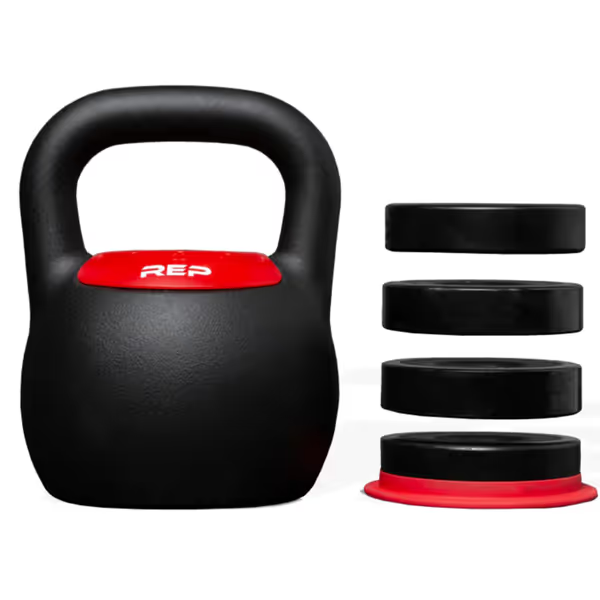
REP Fitness Adjustable Kettlebell
Quick-adjust kettlebell replaces 5 weights for efficient, compact workouts.
$159.99
Weight Range20–40 lb (9–18 kg)
Weight Range20–40 lb (9–18 kg)
Pros
Fastest weight adjustments on the market.
Replaces 5 kettlebells, saving space.
Matte powder-coated grip, durable design.
Cons
Internal weights can clunk or feel loose.
Only 5 settings; limited incremental progression.
Customers praise its easy adjustment and versatile, traditional shape, though some note internal weight looseness.
Customers praise its easy adjustment and versatile, traditional shape, though some note internal weight looseness.
This is where a kettlebell offers a one-tool format: five loads in one body. The 20-40 lb configuration advances in 5-lb steps. Compared with the 52.5- and 60-lb-per-dumbbell options discussed earlier, its maximum is 40 lb.
Bowflex's SelectTech 840 Adjustable Kettlebell provides another reference point: six settings: 8, 12, 20, 25, 35, and 40 lb, selected by a dial. Its listed dimensions are 8.8 × 7 × 12.5 inches. Notice the progression pattern: the five intervals between those settings are not uniform—4, 8, 5, 10, and 5 lb. That can be perfectly acceptable if those six loads fit your program, but it is a poor match if you specifically need closely spaced increases.
The apartment factor: noise is a handling problem first
A quiet adjustable dumbbell system cannot be selected from weight range alone.
Use a controlled pre-purchase or return-window check instead. Keep the conditions consistent:
- Use the same location and floor surface for every check.
- Test the real actions: picking up from the cradle, returning under control, and changing the selected load.
- Do not drop weights. That is not a relevant home-apartment condition and it obscures the handling noise you actually need to manage.
- Listen for two sound types: airborne clicks/rattle and lower-frequency thuds when equipment is returned to the floor.
- Record the result in practical units: number of adjustments completed, seconds per changeover, and a simple sound-meter reading if you have one. Record distance from the equipment and time of day as well.
For shared spaces, favor controlled sets and controlled returns, not noisy exercises and not impacts.
Space math that prevents buyer's remorse
Manufacturer "replaces X weights" statements describe selectable loads, not a verified floor-space comparison. Treat them as a convenience summary, then measure your actual storage zone.
For example:
- REP says its 20-40 lb adjustable kettlebell covers five settings.
- Bowflex says the 840 represents six kettlebell settings from 8-40 lb.
- Bowflex says the 552 pair replaces 15 sets of weights.
- REP says a fully expanded 60-lb QuickDraw pair can replace the need for 12 fixed dumbbell pairs from 5-60 lb.
The important distinction in space-saving home gym design: the QuickDraw pair has a documented cradle measuring 20.6 × 8.45 inches, while the Bowflex 840 kettlebell measures 8.8 × 7 × 12.5 inches. The product data does not establish which occupies less total floor area in every room, so measure the actual storage zone before choosing.
What the research can, and cannot, say about results
A 12-week randomized trial involving 60 sedentary obese male college students aged 17-26 found that the kettlebell-training group improved body-fat and VO2max measures versus passive control. That is a meaningful result in that specific population and program.
It is not evidence that kettlebells outperform dumbbells. The trial compared kettlebell resistance training with bodyweight training and passive control (not dumbbell training). A tool choice still has to be made on adherence, available loads, room constraints, and the movements you can perform consistently and quietly.
FAQ
Are kettlebells more effective than dumbbells?
The 12-week trial discussed here compared kettlebell training with bodyweight training and passive control, not dumbbell training. It showed favorable body-fat and VO2max changes versus no training in a defined population, but it cannot establish a kettlebell advantage over dumbbells.
Which dumbbells are best for a home gym?
There is no universal winner. Choose by required range, increments, adjustment system, and measured storage space. In this comparison, QuickDraw offers configurations up to 60 lb per dumbbell and a documented 20.6 × 8.45-inch cradle; the Results Series 552 offers 15 settings up to 52.5 lb per dumbbell in a 16.9 × 8.3 × 9-inch body.
Which is better for weight loss: dumbbells or kettlebells?
The available evidence does not establish a winner. The kettlebell trial found body-fat reduction versus passive control, but did not compare kettlebells with dumbbells.
Final pick: buy for your repeatable session
Choose adjustable dumbbells if you want the broader first purchase: paired loading, more documented progression options, and top-end ranges of 52.5-60 lb per dumbbell in the examples here. Choose an adjustable kettlebell if your plan genuinely revolves around the kettlebell format and a single central handle is more useful than two adjustable handles.
Your actionable next step: mark out the equipment zone with tape, including QuickDraw cradle space if that is the model you choose; list the next five loads you expect to use; then prioritize the system that covers those loads without forcing awkward storage or uncontrolled returns. That is the small-home-gym decision that lasts, quiet, measurable, and repeatable.
Related Articles