Best Adjustable Dumbbells for Quiet, Upgradeable Home Gyms
By Mateo Alvarez • 11th Oct
At a glance
The PowerBlock Pro 50 is the strongest fit for a compact home gym when 50 pounds per hand is your intended endpoint—not when you want to add heavier stages later.
- 1. Best overall: Choose the Pro 50 for fixed-range training, limited floor space, and quick magnetic-pin adjustments. PowerBlock also supports separate kettlebell, curl-bar, and straight-bar attachments, but they do not increase dumbbell capacity. View on Amazon
- 2. Best alternative use case: Choose an expandable system instead if your strength goals may exceed 50 pounds per hand.
- 3. What decides it: Confirm that 50 pounds per hand covers your foreseeable work, then plan controlled set-downs and storage. The evidence reviewed here does not independently verify its noise, vibration, durability, or long-term selector performance.
Important: The article supports a strong use-case recommendation, not an evidence-based ranking against competing adjustable dumbbells.
Adjustable dumbbells are usually the right starting point when a full rack would take over the room, but "best" depends on more than maximum weight. For apartment lifters, parents training around nap windows, and anyone who needs the room to return to normal afterward, the better choice is the one that keeps setup friction low without forcing a bad long-term compromise. The PowerBlock Pro 50 is a compact, quick-select option worth a close look, but it is not an upgradeable system. That distinction matters before you buy.
Note: the evidence reviewed here does not include independent tests for this model's noise, vibration, drop impact, or long-term durability. So this review separates what PowerBlock specifies from what you should verify in your own space.
1. Start with the decision that prevents buyer's remorse: fixed capacity or staged growth
The phrase "buy now upgrade later dumbbells" describes a real buying priority: begin with a lighter range, then add capacity as your training advances. A stage-based dumbbell system is built around that path.
The PowerBlock Pro 50 Adjustable Dumbbells do not fit that category. They are explicitly non-expandable and top out at 50 pounds per hand. PowerBlock explains that the included 5-pound plates occupy the available handle space, leaving no room for additional plates or expansion rails. They also are not compatible with Pro 100 EXP or Pro 100 Commercial handles.
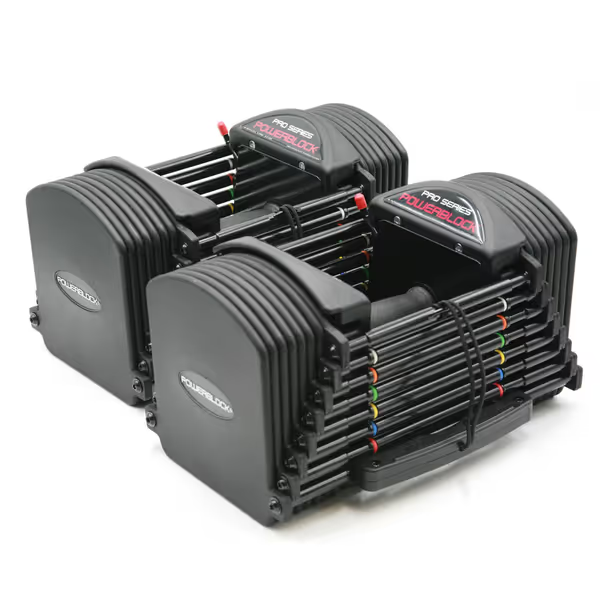
POWERBLOCK Pro 50 Adjustable Dumbbells
Quiet, compact, and quick-adjust for small-space, neighbor-friendly lifting.
$466.65
Replaces16 pairs (825 lbs) of free weights
Replaces16 pairs (825 lbs) of free weights
Pros
Fast, secure magnetic pin weight changes
Durable steel build with 5-year warranty
Compact footprint (12.5" L x 7" W x 7.25" H)
Cons
Cannot expand past 50 lbs
Shape may limit some exercises
Customers praise the build quality, easy weight changes, and durability, considering them good value.
Customers praise the build quality, easy weight changes, and durability, considering them good value.
That is not automatically a drawback. It is a clean fit if 50 pounds per hand is a deliberate endpoint for your pressing, rowing, curls, lunges, and accessory work. It is the wrong fit if you already know heavier dumbbell loading is part of your plan.
Use this one-question filter before comparing anything else:
- Choose a fixed-capacity pair when 50 pounds per hand covers the work you intend to do for the foreseeable future.
- Choose an expandable platform when your priority is preserving a heavier path later, even if you start lighter today.
Do not mistake accessory compatibility for expansion. The Pro 50 works with PowerBlock's Pro Series kettlebell handle, EZ Curl Bar, and Straight Bar attachments, which can broaden exercise formats. They do not increase the dumbbells' 50-pound capacity.
Small frictions decide whether today's workout happens or doesn't.
That includes the friction of discovering, six months in, that a product cannot become the tool you now need.
2. Best compact fixed-range pick: PowerBlock Pro 50
For the right buyer, the Pro 50's case is straightforward: it consolidates a broad working range into a small pair of home gym weights.
What it offers
- Range: 5 to 50 pounds per dumbbell, sold as a pair.
- Selections: 19 selectable weights, using 2.5- and 5-pound increments.
- Official dimensions: 13 x 7 x 7.25 inches per dumbbell.
- Construction: Urethane-coated steel plates.
- Adjustment: Magnetic selector pin.
- Adjustment setup: PowerBlock says no base stand is required to change weights.
The compact stated dimensions are the meaningful comparison point for a shared room. Rather than allocating floor space to a long run of individual dumbbells, you can assign one consistent storage location for the pair. Adjustable dumbbells as a category are widely valued as a space-saving alternative to a full rack, and potentially a more cost-efficient route than purchasing an entire rack.
The magnetic pin is also central to the Pro 50's appeal. You select the desired weight rather than adding and removing individual plates. PowerBlock describes that change as quick; however, there is no independent data verifying a specific adjustment time. If your sessions rely on supersets, the practical test is simple: can you make the selection cleanly, return the dumbbells to their place, and begin the next movement without breaking your focus?
In a small household, that predictable sequence matters more than heroic 75-minute sessions. I learned this when training lived inside nap windows: a well-labeled selection point and an uncluttered landing spot can preserve the small slice of time you actually have.
3. Quiet-home-gym verdict: promising materials, but no verified noise score
Quiet is not a binary product feature. There is the sound of adjustment, the sound of the dumbbell meeting its resting surface, and the vibration that can travel through the floor. Building construction and training habits change the result.
PowerBlock says the Pro 50's urethane-coated steel plates provide smooth, quiet performance. That is a manufacturer claim, not an independently verified sound or vibration result. The evidence reviewed here includes no independent decibel readings for the Pro 50, no floor-type comparison, and no independent assessment of rattle.
That gap should shape how you buy, not stop you from buying.
A quiet-use checklist for any adjustable pair
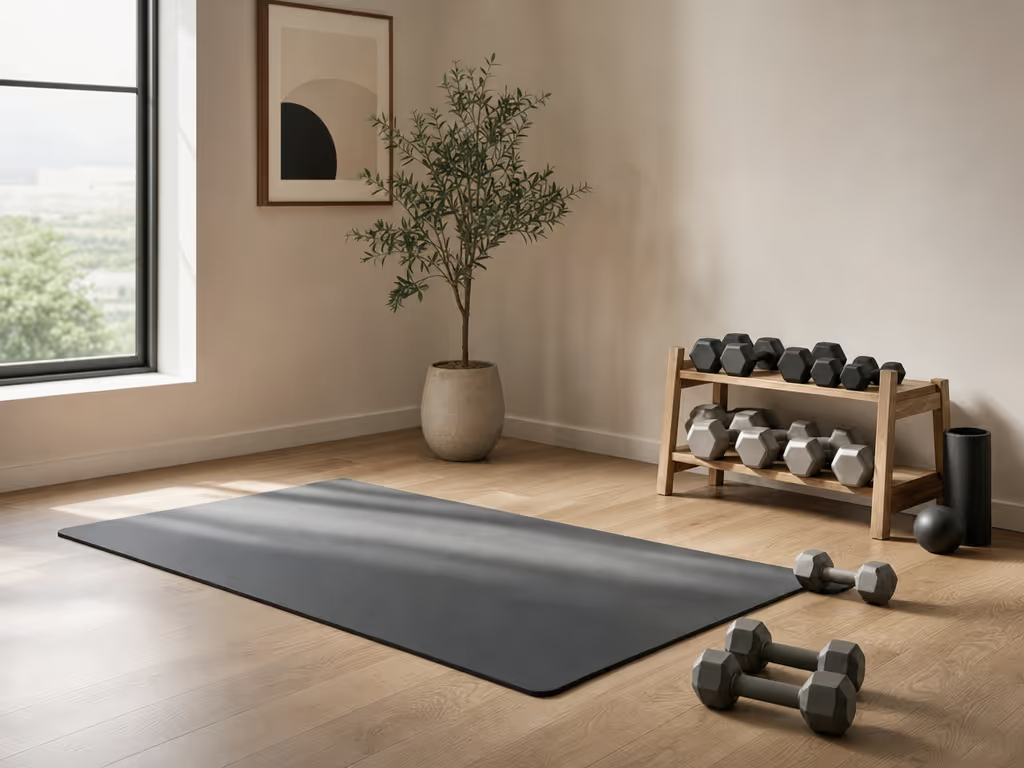
- Plan to place, not drop. A quiet session starts with controlled set-downs and deliberate returns to the storage position.
- Give the pair a fixed landing zone. Choose a stable, protected surface in the same place each time. This reduces hurried handling at the end of a set.
- Test the exact routine you will use. Early-morning rows and late-night floor presses can create different contact and vibration patterns than standing curls.
- Listen during the return-to-storage step. That is often where rushed sessions get loud.
- Treat mats as part of a system, not proof of silence. Do not assume any mat eliminates structure-borne vibration in every building.
For a light sleeper, downstairs neighbor, or sleeping child, a product page's word "quiet" should be the beginning of your evaluation, not the final answer. For a broader look at real-world sound differences, compare these claims with an apartment-safe adjustable dumbbell noise comparison. Set up your training so every rep ends under control.
4. The progression advantage: 2.5-pound options where they count
The Pro 50 has 19 selectable weights from 5 through 50 pounds per hand, with 2.5- and 5-pound increments. That is more useful than a simple top-end number suggests.
Small changes give you a way to progress without making every increase a large leap, which is why choosing the right dumbbell weight increments matters for different exercises. For lifters building consistent home sessions, that means you can adjust the load to the movement rather than force every exercise into the same jump size.
The key is to look at the range exercise by exercise:
| Training need | What to check before buying |
|---|---|
| Pressing and rows | Whether 50 pounds per hand will remain sufficient for your current and expected work |
| Curls, raises, and accessory work | Whether the 2.5- and 5-pound selections give you manageable progression |
| Supersets | Whether the selector-pin workflow suits frequent changes |
| Long-term strength goals | Whether a non-expandable ceiling conflicts with the loads you expect to need |
PowerBlock positions the Pro 50 toward beginner-to-intermediate lifters who are confident that 50 pounds per hand is enough for their presses, curls, rows, lunges, and most accessory work. That is useful guidance, but it is not a universal verdict. A 50-pound ceiling can be ample for one lifter's home plan and limiting for another's.
5. What "upgradeable" can mean - and what it does not mean here
It helps to separate three different ideas often blurred together in adjustable-dumbbell shopping:
Weight upgradeability
Can the dumbbell itself gain more capacity later? For the Pro 50, no. It cannot expand beyond 50 pounds per hand.
Exercise-format flexibility
Can the existing weights be used in a different format? For the Pro 50, yes, through compatible Pro Series attachments for kettlebell, EZ curl-bar, and straight-bar use. These are separate accessories and do not add weight capacity.
Room-level upgradeability
Can your overall home gym grow around the dumbbells? Yes, but make that plan intentionally. A compact pair can be the stable core of a training corner while other equipment is added only when it earns its footprint.
This is the cleanest way to evaluate an adjustable dumbbells kit. Do not buy based on the word "expandable" unless the expansion you mean is specifically additional dumbbell weight.
6. Warranty and ownership: read the component terms, not just the headline
For home use, PowerBlock's detailed warranty table lists:
- Five years of limited coverage for the handle assembly and weight plates.
- One year of limited coverage for the selector pin and micro weights.
- No warranty for commercial use on home models.
Those component-specific terms are more useful than treating the entire set as covered for the same period. Warranty terms across adjustable dumbbell brands can change, so confirm the current policy at purchase, especially if the pair will be used in a setting that might be considered commercial.
The practical ownership question is not "Will I baby these?" It is: Can this system live where I train, return to the same place after every set, and keep the session moving without constant tinkering? That is the standard a compact adjustable system should meet.
7. Who should buy the Pro 50 - and who should pass
Buy the PowerBlock Pro 50 if you want:
- A compact pair covering 5 to 50 pounds per hand.
- 2.5- and 5-pound selection options rather than only large jumps.
- Magnetic-pin weight selection and no required base stand for adjustments.
- A neat alternative to dedicating a room to a conventional dumbbell rack.
- Optional compatibility with PowerBlock's Pro Series kettlebell, curl-bar, and straight-bar attachments.
- A fixed system that you expect to keep within the 50-pound-per-hand ceiling.
Pass if you need:
- A true staged expansion path above 50 pounds per hand.
- Confirmed decibel, vibration, or floor-impact testing before purchase.
- Independent data on long-term selector durability, handle comfort, rattle, or real-world noise performance.
- Compatibility with Pro 100 EXP or Pro 100 Commercial handles.
This is not a "settle now and upgrade later" dumbbell pair. It is a "choose your finished range now" pair.
8. FAQ: the practical answers before checkout
Are adjustable dumbbells worth it?
They can be worthwhile when replacing a full dumbbell rack with a compact, selectable system solves a real space problem. Independent category-level testing and research describe adjustable dumbbells as a space-saving and potentially more cost-efficient alternative to owning an entire rack. Whether they are worth it for you depends on your required weight range, preferred adjustment workflow, and living situation.
What are the downsides of adjustable dumbbells?
For the Pro 50 specifically, the main tradeoff is its fixed 50-pound-per-hand maximum. It is non-expandable, so buyers who anticipate needing heavier dumbbells later should not frame it as a staged-growth purchase.
Which is better: fixed dumbbells or adjustable dumbbells?
Neither is automatically better; an adjustable-versus-fixed dumbbell comparison can help clarify which tradeoffs fit your space and training style. Adjustable dumbbells can be a space-saving alternative to a full dumbbell rack. Fixed dumbbells may suit a setup where dedicated space is available and no selection step is desired. Choose based on the constraint that matters most in your room and routine.
Is 50 pounds per adjustable dumbbell enough?
It can be enough for beginner-to-intermediate lifters whose pressing, curl, row, lunge, and accessory work fits within that range. It is not enough for everyone. Review the loads you use now and the loads you expect to need before committing, because the Pro 50 cannot be expanded past that limit.
Final verdict
The PowerBlock Pro 50 is a strong compact choice for a quiet-minded home gym if 50 pounds per hand is your intended finish line. Its 19 selectable weights, 2.5- and 5-pound increments, magnetic selector pin, and small stated footprint directly address the clutter and changeover problems that derail short sessions.
Its limitation is equally clear: it is not a stage-based dumbbell system and not a "buy now upgrade later dumbbells" solution. PowerBlock's quiet-performance language is encouraging, but the evidence reviewed here includes no independent noise or vibration data to promise neighbor-proof training.
Make the purchase decision in this order: confirm the 50-pound ceiling, assign a controlled storage and landing spot, then build the habit around fast, repeatable transitions. Consistency behind a closed door beats a complicated setup waiting for the perfect workout.
Related Articles