Adjustable Dumbbells: Handle Length and Head Clearance Guide[1][2][9]
By Mateo Alvarez • 15th Oct
Quick answer
For reported curl and press clearance concerns, check working length and head bulk at the settings you actually use—not just the grip or maximum weight.
- Essential context: Do not use handle length as a substitute for overall or working length, and do not treat working length as usable grip length or head width.
- Why it matters: Reported concerns include plates meeting during curls, frame ends contacting the ribs during pressing, and bulky designs limiting the stretched position of chest presses.
- Important caveat: There is no evidence-based universal clearance number or fit rule. These concerns are not established for every design or exercise, especially rows and floor presses, so judge the specific dumbbell in the movements you use.
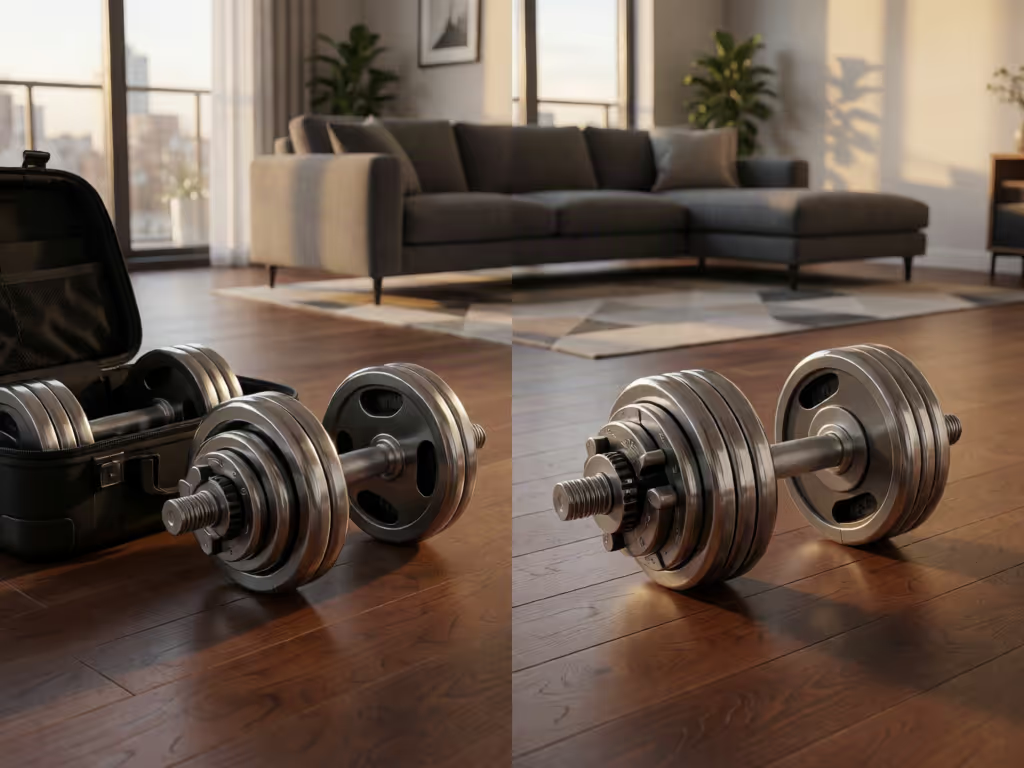
Dumbbell head clearance deserves as much attention as weight range and adjustment speed. The practical issue is simple: some designs retain the same long frame at light and heavy selected settings. For apartment lifters training inside a nap window, that mismatch can turn an otherwise clean superset into a string of small resets.
This is not a search for a perfect shape. It is a way to identify whether the geometry of a pair suits the exercises you actually repeat, before that geometry becomes one more reason to delay a quiet session.
Start with the terms in the specifications
Product listings can make dimensions sound more precise than they are. Keep these limitations in mind when doing a handle length comparison:
- Handle or overall length: a manufacturer guide recommends checking whether a product page publishes either at multiple selected settings, but it does not define either term.
- Working length: a manufacturer term that may be discussed in relation to the selected weight; consult the model-specific specifications rather than treating it as usable grip length or head width.
- Head size or head width: the collected evidence does not provide a reproducible method for measuring these dimensions.
The manufacturer guidance does not define handle length as overall or working length, and working length should not be treated as usable grip length or head width without model-specific specifications. The collected evidence does not define head clearance or provide a reproducible way to measure it, so a compact-looking end is not a clearance measurement in that evidence. For a deeper look at handle comfort and ergonomics, compare grip design with the exercises you perform most often.
No collected official manual or safety documentation gives category-wide clearance instructions for adjustable dumbbells. In practical terms, use the phrase as a personal fit check: does the loaded end of the dumbbell stay out of the path you need for the movement? Apply that question to each exercise and selected setting you plan to use.
Small frictions decide whether today's workout happens or doesn't.
Why adjustable-dumbbell length can change the feel of light sets
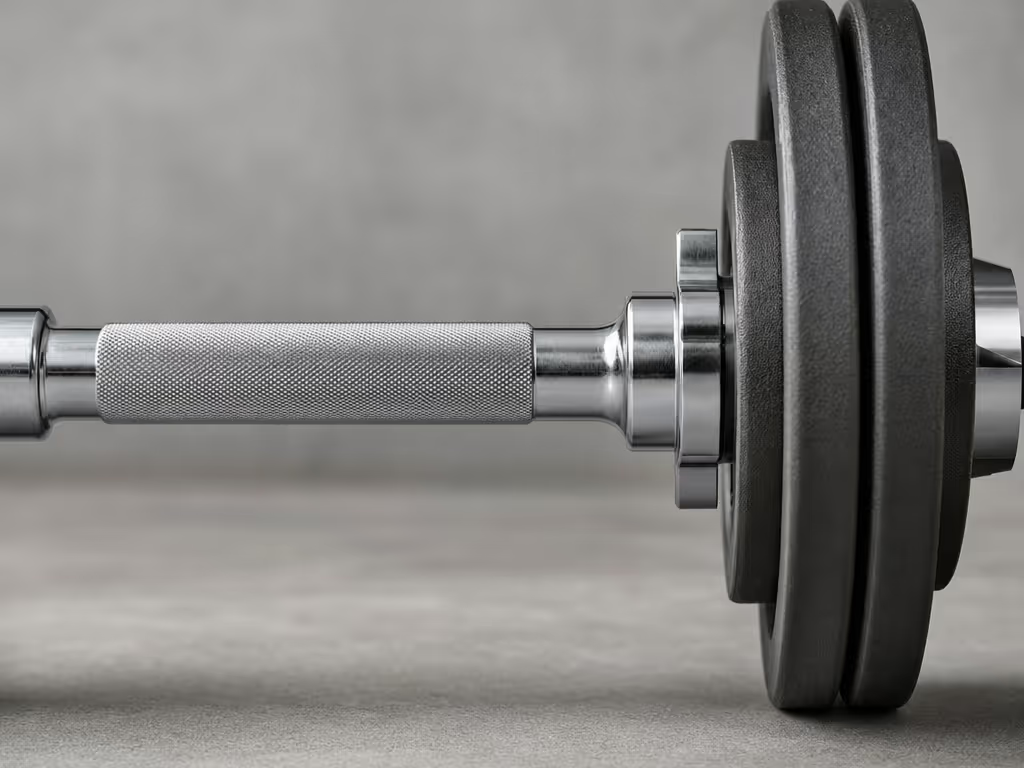
Some adjustable-dumbbell designs and mechanisms retain a long frame whether you select a light or heavy setting. A manufacturer guide specifically flags this fixed-length approach as a potential issue: plates may bump together during curls, and the ends of the frame may contact the ribs during pressing. Those are manufacturer claims, not a universal finding for every adjustable dumbbell or every variation, but they point to the right buying question.
Does the working length change with the weight setting you will use most?
The evidence does not establish every long frame as a problem. The reported concerns are specific: plates meeting during curls and frame ends contacting the ribs during pressing. To understand why size and weight distribution can change the feel of a lift, consider how the mass is positioned relative to your hand and the exercise path. The problem comes from assuming that a lower selected weight tells you how the frame length changes. With some designs, it does not.
This matters most when your workout uses several lighter to moderate settings: warm-up work, curls, pressing accessories, and higher-repetition blocks. If each change leaves you managing a long frame in a tight range of motion, the convenience of rapid adjustment can be partly lost to repositioning.
The listing detail worth finding
When a product page publishes it, look for handle or overall length at multiple weight settings, rather than only one headline dimension. One manufacturer guide recommends checking exactly that information.
If the listing gives only a single overall length, treat it as incomplete fit information. That figure alone does not show whether the dumbbell gets shorter at lighter selected settings or how the bulk is distributed.
Avoid turning this into a hunt for a magic number. The available evidence does not establish a minimum, ideal, or universally safe handle length, overall length, head width, or clearance allowance.
Dumbbell clearance for presses: where bulk is most clearly relevant
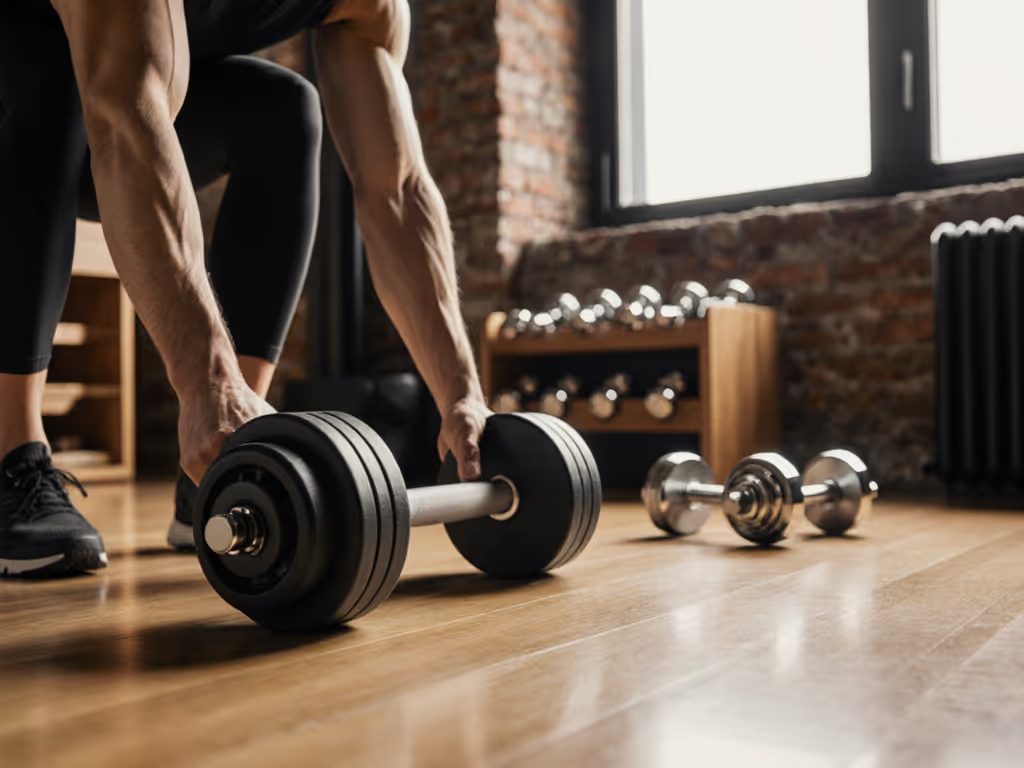
The best-supported exercise-specific caution is the chest press. Independent testers have reported that bulky, awkward adjustable-dumbbell designs can limit range of motion and interfere with a full stretch on chest presses.
The report does not establish the same effect for every design or person. It does mean that chest presses belong near the top of your fit checklist if they are a staple in your training.
A calm press-fit check
Before committing to a set, make the question concrete:
- Name the press you perform most often. Do not evaluate a pair against an imaginary all-purpose workout.
- Consider the light and moderate settings, not only the maximum load. These are often the settings used for longer press sets.
- Watch for end-to-torso contact and for bulk that changes your comfortable bottom position. Contact or a forced change in path is useful feedback, not a form failure to push through.
- Decide whether the trade-off is acceptable for your actual routine. A pair can be excellent for one household's training and wrong for another's main lift.
Keep the conclusion narrow. Evidence about bulky adjustable dumbbells and chest-press stretch should not be stretched into claims about overhead presses, floor presses, injury risk, or joint mechanics. One press-biomechanics study models barbell pressing, not adjustable-dumbbell dimensions.
Curls: check the space between the bells
For curls, the potential issue is different. With a fixed-length frame, a manufacturer guide reports that plates can bump together. That is not a guaranteed problem, but it is worth considering when curl volume is important to you.
Use this simple decision rule: if two loaded dumbbells would repeatedly meet in the portion of the curl you naturally use, do not assume you will "get used to it." You may adapt your path, but you may also add a tiny hesitation to every rep. Over a short, time-boxed session, those hesitations add up.
I learned this during the early nap-window months: reducing transitions mattered, but so did removing the small corrections between them. Clear labels and a tray that made changes predictable reclaimed time; choosing geometry that did not demand constant steering protected the flow once the set began. That is nap window layout wins in its least glamorous, most useful form.
A practical checklist for dumbbell dimensions for exercises
Use this checklist while reading specifications, watching a demonstration, or handling a pair in person.
Before you buy
- List your three most frequent movements. Put chest presses and curls on the list if they are regular work, because they have the relevant reported clearance concerns.
- Mark your most-used settings. Do not evaluate only the heaviest configuration.
- Look for dimensions at several settings. Prioritize published working or overall-length information where available.
- Do not substitute grip information for working or overall length. Consult the model-specific specifications.
- Treat missing dimensional detail as uncertainty. Do not fill the gap with an assumption based on photos.
During a hands-on trial, if one is available
- Select a lighter setting and a heavier setting.
- Notice whether the frame remains the same length at both selected settings.
- For your usual chest press, observe whether bulk gets in the way of your comfortable stretched position.
- For curls, observe whether the dumbbells approach each other in the path you naturally use.
- Stop the trial if you find yourself repeatedly modifying the movement simply to accommodate the equipment.
This is not perfectionism. It is a fast compatibility screen. For more practical ideas on space-saving dumbbell storage, consider how the pair will move from its storage spot into your training area and back again. The goal is gear that fades into the session, stores cleanly afterward, and does not invite tinkering when the household is quiet.
What this guide cannot tell you
No evidence here supports a universal clearance number based on height, shoulder breadth, arm length, torso size, mobility, or room dimensions. It also does not establish how adjustable-dumbbell shape affects rows or floor-based movements. If either category is central to your training, judge the specific pair in the specific movement when possible rather than borrowing a chest-press conclusion.
This guide does not evaluate noise levels, floor vibration, lock durability, weight increments, or adjustment speed. Keep those decisions separate so one attractive feature does not hide a meaningful compromise elsewhere.
FAQ
What are the downsides of adjustable dumbbells?
Within the narrow question of shape, some adjustable designs can be bulky or retain a long frame across light and heavy selected settings. A manufacturer guide reports possible interference during curls and pressing for fixed-length frames, while independent testers note that bulky designs can limit the stretched position on chest presses. These are potential trade-offs, not universal flaws.
Is a longer adjustable dumbbell always worse?
Not on the available evidence. The reported concerns apply specifically to fixed-length frames during curls and pressing and to bulky, awkward designs during chest presses. Check whether those reported trade-offs appear in the movements and settings you use most often.
Summary and final verdict
For adjustable dumbbells, the strongest geometry check is not "Are they compact?" It is "Are they compact where I train?" Compare working or overall length across the settings you expect to use, and use model-specific specifications rather than treating grip information as a substitute for working length or head width. Give chest presses and curls extra attention.
The final verdict: choose the pair whose shape creates the fewest course corrections in your repeatable session, not the pair that looks smallest in a product photo. A clean start, a predictable set, and quiet storage afterward will serve consistency better than any heroic workaround.
Related Articles