Dumbbell Training for Bone Density: Safe Home Strength FAQ
By Rowan Takahashi • 15th Aug
Quick answer
Yes—dumbbells can support a broader bone-health routine by providing resistance, but current evidence does not show that adjustable-dumbbell training alone increases DXA bone mineral density, prevents osteoporosis, or reduces fracture risk.
- Key distinction: Dumbbells are strength exercise, not a complete bone-health program. Guidance also considers balance, endurance, and—when appropriate—impact activity, alongside prescribed osteoporosis treatment.
- Safe progression: There is no universal safe starting weight, repetition target, or lifting limit. Progress gradually with controlled technique and a clear, stable home setup.
- Important caveat: People with vertebral fractures—especially with pain, multiple fractures, or hyperkyphosis—should obtain individualized guidance from a clinician or physiotherapist before loaded exercise.
Dumbbell training for bone density can be a useful part of a broader strength routine, but it is not a stand-alone osteoporosis treatment or a guarantee of higher bone mineral density. The practical question behind osteoporosis strength exercises is not "what is the heaviest weight I can lift?" It is: what loading can I repeat with sound technique, a stable home setup, and a risk level appropriate to my bones and medical history?
Dumbbells count as strength equipment alongside body weight and resistance bands. The Royal Osteoporosis Society explains the rationale plainly: working muscles pull on bone, helping maintain or improve bone strength. That is encouraging, but it is not a license for generic heavy lifting, or a promise that dumbbells alone will change a DXA scan.
Quiet strength is measured, not guessed, set after set.
For apartment training, that principle includes movement quality, floor control, and a zero-drop rule. Your rattle budget should be close to zero; bone-focused training has no need for crashing weights into a tray or transmitting impact through a thin floor.
FAQ: Can dumbbells improve bone density?
What dumbbells can and cannot do
Dumbbells provide external resistance. With gradual, appropriately selected loading, they can support muscle-strengthening work that is relevant to bone health. But the available guidance does not establish that adjustable-dumbbell training by itself improves DXA-measured bone mineral density, prevents osteoporosis, or reduces fracture risk.
Bone-health guidance describes both impact exercise and strength exercise as useful components. Some people at higher fracture risk may not be suitable for impact activity, which is exactly why one universal home plan fails the safety test.
A defensible goal is therefore broader than "build density with curls." Use resistance training to build and maintain strength; include balance work; choose other activity appropriate to your situation; and follow prescribed osteoporosis treatment when it is indicated. Exercise and diet matter, but they do not replace medication prescribed for osteoporosis.
Is dumbbell work "weight-bearing exercise"?
Dumbbell work is best categorized as strength exercise. It loads muscles, which in turn apply force to bone. In common bone-health language, weight-bearing activity and muscle-strengthening work are often discussed together, but they are not interchangeable training categories.
That distinction makes the usual weight bearing exercise guidelines easier to apply at home: do not assume that holding a dumbbell turns every movement into a complete bone-health program. Your clinician or physiotherapist can help decide whether and how strength, balance, walking or other activity, and (where appropriate) impact work fit together.
FAQ: Can you strength train with osteoporosis?
Usually yes, with an individual plan, not a borrowed routine
The Royal Osteoporosis Society states that most people with osteoporosis can exercise safely when they choose an activity and intensity appropriate to them. "Appropriate" is doing the work here. A sound plan accounts for:
- fracture risk and any history of fractures;
- pain, movement limitations, and current fitness;
- whether there has been a vertebral (spinal) fracture;
- your prior activity experience and preferences; and
- the actual conditions of your home training space.
People with multiple fractures, a spinal fracture, recovery from fracture, or personal concerns about exercising should speak with a doctor or physiotherapist before starting. Consultation with a physical therapist is particularly important after vertebral fracture when pain, multiple fractures, or hyperkyphosis are present. For equipment considerations during recovery, our guide to rehab-friendly dumbbells covers features such as light increments and secure, non-slip grips.
What changes after a vertebral fracture?
The control condition becomes spine protection. Expert consensus favors spine-sparing, individualized guidance over simplistic rules such as "never lift more than X pounds" or "never twist." That does not mean every load or movement is automatically safe. Exercise prescription should consider impairments, fracture risk, activity history, and personal preference.
For resistance exercise, the consensus advises performing back-extensor or major-muscle-group work in positions that minimize spinal loading whenever feasible. After vertebral fracture, moderate activity is preferred over vigorous activity. A clinician or physiotherapist should determine the loading positions, range of motion, and exercise choices (not an online template).
FAQ: What does safe progressive loading look like at home?
Start with repeatability, not a target number
There is no evidence-backed universal starting dumbbell weight, rep target, or maximum lifting limit for osteopenia, osteoporosis, pain, hyperkyphosis, or fracture history. Anyone giving you one is substituting a neat number for an assessment.
Instead, use progressive loading for bone health gradually according to present fitness and muscle strength. In practice, that means keeping the initial session deliberately easy enough to observe control:
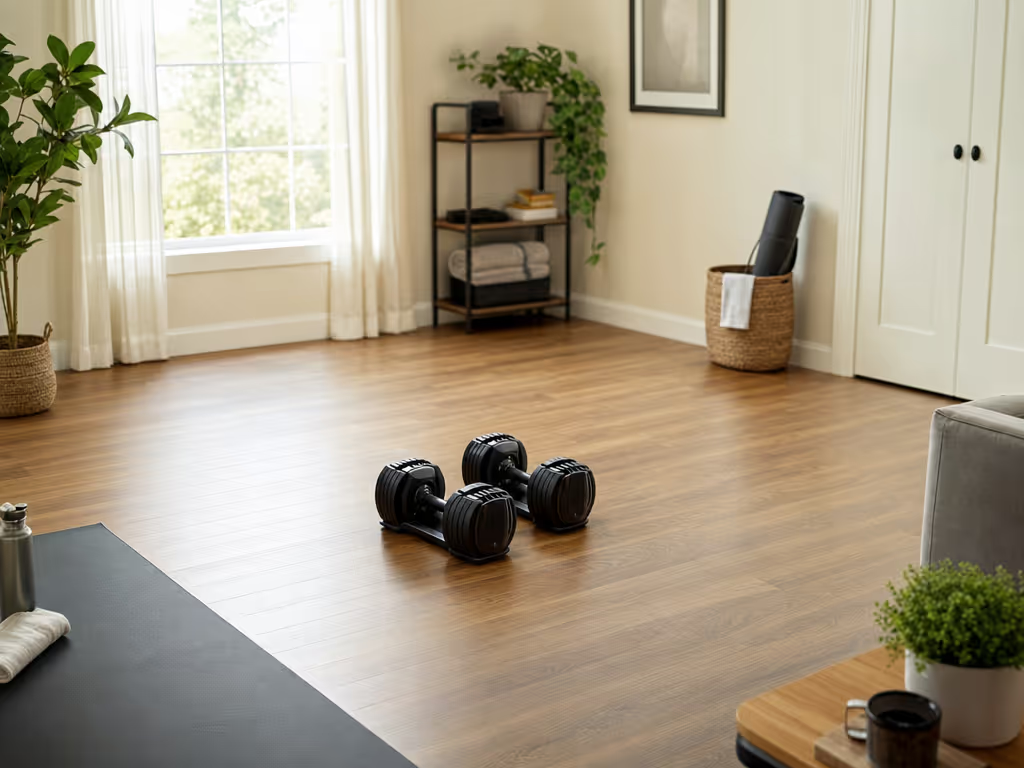
- Set the environment first. Clear cords, loose rugs, clutter, unstable furniture, and poor lighting from the training area. These are documented home fall hazards, and they matter more than a clever program.
- Choose stable positions. Favor a setup that lets you maintain alignment and control the dumbbell from start to finish. For anyone with osteoporosis, minimizing spinal loading when feasible is a useful decision filter.
- Change one variable at a time. Add load, repetitions, range, or session volume gradually (not all at once). Track what changed and how the body responded.
- Keep every return controlled. Lower the dumbbell under control to its storage position. Do not drop it.
- Reassess before advancing. New pain, declining control, fear of the movement, or an unstable setup means hold or step back rather than forcing progression.
This is safer and more useful than chasing a percentage of a one-repetition maximum. Research summarized by ACSM finds that heavier loading can enhance strength in healthy adults under specific conditions, but that finding is not an osteoporosis prescription and should not be transferred to people with fractures or relevant medical concerns.
How often should you train?
For healthy adults, most guidelines call for muscle-strengthening activity involving all major muscle groups on two or more days per week. That is a general healthy-adult benchmark, not a condition-specific prescription for osteoporosis.
For people managing osteoporosis, the more relevant planning signal is consistency at an individually appropriate intensity. The osteoporosis consensus also emphasizes daily balance training and endurance work for spinal extensor muscles; it does not say to lift dumbbells daily. Because balance work can help address fall risk, consider our guide to dumbbell balance training for additional stability-focused ideas.
For postmenopausal resistance training, that distinction remains important: choose a gradual, individually suitable plan rather than copying a high-intensity strength template designed for healthy lifters without a defined disease.
FAQ: Which exercises should you avoid with osteoporosis?
There is no honest universal "do-not-do" list
A generic banned-exercise list sounds safe, but it can be misleading. Consensus guidance favors individualized spine-sparing advice rather than blanket restrictions. The right answer depends on fracture history, symptoms, spinal posture, ability, and the exact movement being considered.
If you have a vertebral fracture, especially with pain, multiple fractures, or hyperkyphosis, do not self-prescribe loaded or complex movements from a social-media list. Seek a physiotherapist's assessment first.
For home training, keep dumbbells and the training area clear of loose rugs, cords, clutter, unstable furniture, and poor lighting. In a small space, the footprint tax is real: a clean, well-lit training lane is part of the program.
FAQ: Do adjustable dumbbells make bone training safer?
Adjustable dumbbells are strength equipment, not a treatment for osteoporosis or a substitute for prescribed treatment. For bone-health exercise, build a gradual plan based on fitness and muscle strength, while accounting for fracture risk, activity history, personal preference, and home fall hazards.
Keep the training area clear of loose rugs, cords, clutter, unstable furniture, and poor lighting. Product choice does not replace an exercise plan tailored to your health history and current abilities.
Final verdict
Dumbbells can earn a place in a bone-health routine as strength-training tools, especially when the plan is gradual, controlled, and paired with balance work and other appropriate activity. They are not a substitute for medical care, prescribed medication, or individualized guidance after fractures.
The decisive filter for safe strength training for osteopenia or osteoporosis is not a fixed poundage. It is whether your training matches your fracture risk, history, movement capacity, and home conditions. Build slowly, keep the floor clear, lower every weight quietly, and get professional input when spinal fracture, pain, multiple fractures, or hyperkyphosis changes the equation. That is the low-noise, high-control route to training you can keep doing.
Related Articles