Adjustable Dumbbell Weight Increments for Quiet Progress
By Lila Menon • 3rd Oct
What to do
Use percentage-based jumps rather than judging increments by pounds alone. For healthy adults, ACSM recommends increasing load by 2–10% after performing one or two repetitions beyond the target.
- Start with: Choose a consistent basis for the calculation and keep it the same: (next weight − current weight) ÷ current weight × 100. Using a per-dumbbell convention, a 2.5 lb jump is 25% from 10 lb but 10% from 25 lb.
- Then: Choose the next setting only if your repetitions, joint position, and lowering control remain steady.
- Important prerequisite: If the next jump is too large, adjust repetitions, volume, tempo, or rest, or revisit exercise order instead of forcing the load.
Important: The 2–10% recommendation applies to healthy adults under the stated repetition condition; it does not establish a universally correct increment or personal maximum weight.
With adjustable weight settings on dumbbells, the most useful question is not "What is the biggest jump available?" It is "Can I make the next jump while keeping the same clean pattern?" The right adjustable dumbbell weight increments make progression feel measured rather than abrupt, especially when you train early, late, or in a shared home where missed reps, rushed setup, and clattering resets are not part of the plan.
For healthy adults, ACSM recommends a 2-10% load increase when you can perform one to two more repetitions than your target at the current workload. That percentage lens turns choosing dumbbell increments from guesswork into a simple calculation.
Comfort that keeps you consistent is performance in disguise.
The Core Rule: Measure the Jump, Not Just the Pounds
A fixed increase can be modest at one weight and huge at another. Use this calculation:
Percentage jump = (next weight - current weight) / current weight x 100
For paired dumbbell exercises, choose a consistent basis for the calculation and use it throughout. The examples below use per dumbbell. If each bell moves from 25 lb to 27.5 lb, that is a 2.5 lb increase on each side, or a 10% jump using this per-dumbbell convention.
Here is what the same-looking increments can mean:
| Current weight per dumbbell | Next increment | Percentage jump |
|---|---|---|
| 10 lb | +2.5 lb | 25% |
| 25 lb | +2.5 lb | 10% |
| 50 lb | +5 lb | 10% |
| 100 lb | +10 lb | 10% |
The takeaway is precise: the same absolute jump represents a larger percentage at lower loads. A 2.5 lb change from 10 lb is a 25% increase, which is above the conditional 2–10% increase recommended by ACSM.
What Increment Options Actually Let You Do
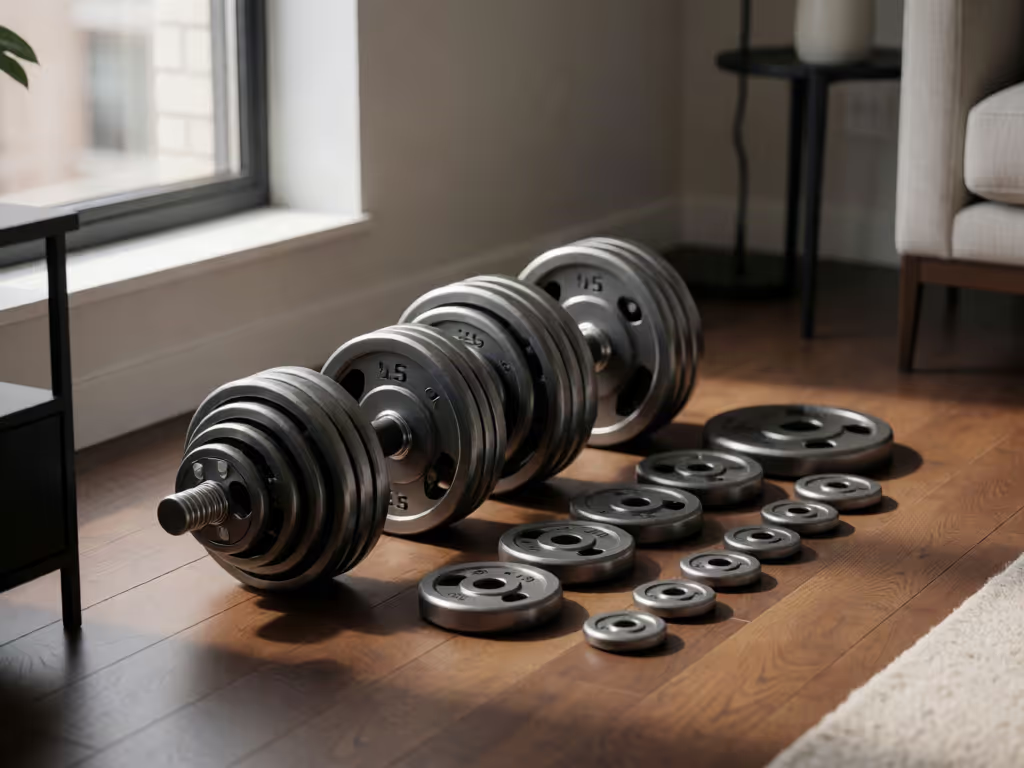
Adjustable-dumbbell systems commonly use 2.5 lb, 4 lb, or 5 lb steps, according to practitioner guidance. None is automatically best. The useful choice depends on the weights you use now, the movements you want to train, and how often you need to change settings.
A 2.5 lb increment gives you more low-load control
At light working weights, finer changes can keep a progression inside the 2-10% framework more often. This matters when a movement is limited by controlled joint position, grip steadiness, or a small muscle group rather than by your willingness to strain.
For dumbbell progression for isolation exercises, do not assume there is a universal "correct" pound jump. Instead, look at the percentage. If your next available setting turns a steady set into shoulder hiking, wrist bending, or a fast, loose lowering phase, the increment may be too large for that exercise at that point.
A 5 lb increment may become more workable as loads rise
A five-pound jump is 10% from 50 lb, but it is 25% from 20 lb. That is why one adjustable system can feel excellent for one part of a workout and blunt for another. A practitioner source similarly notes that 5 lb changes may fit heavier ranges better, while a 5-to-10 lb jump can be substantial for a new lifter.
This is not a rule that lower-body work "deserves" larger jumps or that all curls require tiny ones. The guidance collected here does not establish a universal pound mapping for isolation, upper-body, and lower-body movements. The percentage, your repetition target, and your actual control are the better checks.
Choosing Dumbbell Increments by Movement Demands
Think in categories, but avoid rigid labels. You are selecting an increment that lets you preserve the movement you intended to train.
Upper-body dumbbell weight jumps
For pressing, rowing, and overhead patterns, assess the next setting with a short checklist:
- Can you set your shoulder position before the first rep?
- Do both dumbbells travel predictably rather than twisting or drifting?
- Can you keep the wrist stacked over the forearm (a neutral wrist) through the hardest portion?
- Can you lower the bells without a hurried catch or a noisy reset?
If the answer changes from yes to no with the new setting, keep the present load and build another form of demand first. Evaluate handle design and weight distribution separately from the percentage used to judge a load increase.
Lower body dumbbell weight progression
Lower-body exercises do not make any larger jump automatically appropriate. Use the same percentage calculation, then watch the pattern: torso position, foot pressure, knee tracking, and your ability to place the dumbbells down with control.
A larger absolute increment may fall within the 2-10% range at a heavier current load. But when it does not, you still have options besides forcing it. That matters in apartments, where an uncontrolled final rep often becomes the loudest part of the session.
When the Next Setting Is Too Big, Progress Without Forcing It
Progressive training with adjustable dumbbells does require a progressive plan, but load is only one lever. ACSM identifies changes in repetitions, volume, tempo, and rest as ways to alter or increase training demand without immediately increasing the dumbbell setting. It separately recommends ordering large-muscle before small-muscle exercises, multi-joint before single-joint exercises, and higher-intensity before lower-intensity exercises to preserve exercise intensity.
Consider these programming options:
- Add repetitions at the current load. If your target is 8 reps and you can perform 9 or 10, you have useful information for a later load increase.
- Increase total volume gradually. Total volume is repetitions multiplied by resistance. An extra well-executed set or carefully added repetitions can raise the session's demand.
- Adjust tempo with submaximal loads. Use a deliberate lowering phase or a brief controlled pause only if it lets you retain position and breathing.
- Adjust rest to match the goal. Shorter rests can increase endurance demand; longer rests can better support strength and power work.
- Revisit exercise order. Large muscle groups, multi-joint work, and higher-intensity exercises are generally placed before smaller-muscle, single-joint, and lower-intensity work when preserving intensity is the aim.
You do not need to take every set to momentary muscular failure to make muscle-focused training productive. A systematic review and meta-analysis found no evidence that training to momentary muscular failure was superior to non-failure training for hypertrophy. In a quiet home, stopping a rep while it is still technically yours can also protect the rhythm of the room: lower with control, return the bell to its cradle gently, and keep a quiet nervous system.
A Simple Progression Log for Adjustable Dumbbells
Use a quiet progress-tracking method that makes the next decision obvious. For each exercise, record:
- weight per dumbbell
- target repetitions and repetitions completed
- sets completed
- whether you had one or two repetitions beyond the target
- one form note: "wrists stacked," "last rep rushed," or "quiet lower"
Example: if you plan 3 sets of 8 and complete 8, 8, and 10, you have met the one-to-two-repetitions-above-target condition for considering a 2–10% load increase. Calculate the next setting's percentage change first. If it is sensible and your setup remains controlled, try it. If it is too steep, use one of the non-load progressions above and reassess later.
This approach is especially useful when your workout sits between a partner's meeting and a child's nap. Consistent sessions beat sporadic heroic ones.
FAQ: How Heavy Should My Adjustable Dumbbells Be?
The guidance collected here does not prescribe an exact maximum capacity for a particular person, goal, or exercise. Start the decision with the exercises you intend to do, whether you will use one dumbbell or two, the weight range you expect to need, the increment size, and how frequently you must change weight during a session.
For progression, the more important question is often: Does the system offer a next setting that is manageable relative to my current working weight? Consider the system's weight range alongside its increment size when choosing adjustable dumbbells.
Further Exploration: Build Your Own Increment Map
Before choosing a system or changing your current plan, list your five most frequent dumbbell exercises. Beside each one, write the present weight per hand, the next available setting, and the percentage jump. Then flag any jump above 10%.
Those flagged movements do not mean you are stuck. They show where you can adjust repetitions, volume, tempo, or rest, or revisit exercise order until the next load is genuinely yours. That is the quieter, more durable kind of progress: deliberate hands, stable wrists, controlled returns, and a training habit your space can support.
Related Articles