Adjustable Dumbbells: Quiet Stage 1 to 90 lb Expansion
By Rowan Takahashi • 29th Sep
In short
The PowerBlock Elite EXP Stage 1 is a sensible compact option if you want 5–50 lb per hand now and a retailer-listed path to 70 or 90 lb per hand later.
- Main takeaway: It is sold as a pair with 16 listed settings, and the stated expansion kits are sold separately.
- Who this helps: Choose it if storage space matters more than the simplicity of fixed dumbbells and you want to delay higher-capacity purchases until your training requires them.
- Important caveat: No product-specific noise, durability, adjustment-speed, or independent hands-on testing supports stronger claims.
Important: Whether 50 lb is enough depends on your exercises and progression, so the available evidence cannot establish a universal stopping point.
For apartment-minded lifters, adjustable dumbbells and compact home gym dumbbell sets solve the same practical problem: cover useful loads without turning a spare corner into a rack room. The PowerBlock Elite EXP Stage 1 pair starts at 5 to 50 lb per hand, then offers a stated stage 1 to 90 lb expansion path. That is an efficient range on paper, but a quiet-home purchase needs a more skeptical read than "expandable" alone.
The key limitation up front: there is no product-specific decibel, vibration, rattle, or lift-off test available here for this Elite EXP set. Do not treat its compact format or pin-based adjustment as proof that it is quiet in a thin-floored building. Quiet strength is measured, not guessed, set after set, as shown in this adjustable dumbbell noise comparison.
The short verdict
The PowerBlock Elite EXP Stage 1 is a strong fit for the buyer who wants one compact adjustable pair now, values relatively fine listed weight choices through 50 lb per hand, and wants the "option" to increase capacity later rather than commit to 90 lb immediately.
Its decision case rests on four documented points:
- Stage 1 range: 5 to 50 lb per dumbbell.
- Expansion path: retailer-listed Elite EXP Stage 2 and Stage 3 kits can take the pair to 70 and then 90 lb per hand; both are sold separately.
- Space profile: the retailer lists each dumbbell at 12 × 6 × 6 in.
- Critical compatibility rule: Elite EXP and Elite USA/Elite USA 90 expansions are not interchangeable.
The caveat is equally important: a compact adjustable system trades a full fixed-dumbbell rack for moving parts and a more complex shape. Adjustable dumbbells as a category can save substantial space, but category-level testing also flags potential durability complexity and range-of-motion interference from bulkier designs on some exercises. Neither point establishes how this particular model will feel, wear, or sound in your home.
Product review: PowerBlock Elite EXP Stage 1, 5 to 50 lb per hand
The Elite EXP Stage 1 is sold as a pair. Its listed 5 to 50 lb range is per hand, not combined across both dumbbells. If both handles are set to 20 lb, you are holding 20 lb in each hand - 40 lb across the pair.
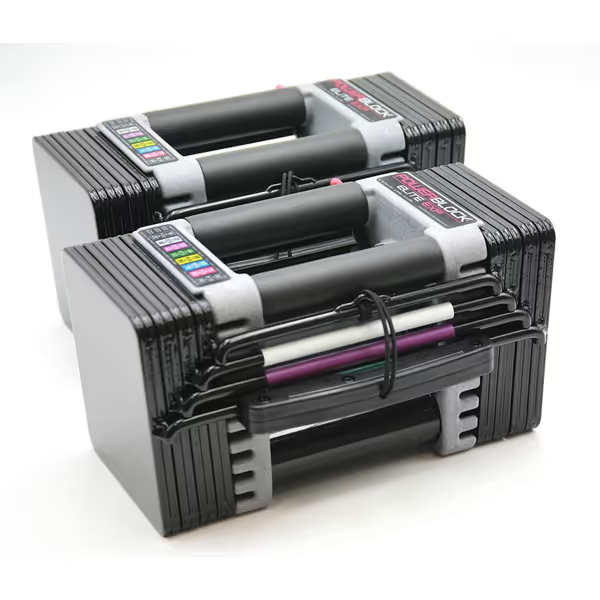
POWERBLOCK Elite EXP Adjustable Dumbbells, 5-50 lb.
Quiet, durable, and expandable for a clutter-free home gym.
$399
Weight Range5-50 lbs per hand (expandable to 90 lbs)
Weight Range5-50 lbs per hand (expandable to 90 lbs)
Pros
Durable steel build for long-lasting use.
Fast, secure magnetic pin weight adjustments.
Space-saving design replaces 16 pairs of dumbbells.
Cons
Some users report minor weight balance issues.
Expansion kits sold separately and not compatible with all PowerBlock models.
Customers praise its durability, space-saving design, and easy weight changes, preferring it over Bowflex.
Customers praise its durability, space-saving design, and easy weight changes, preferring it over Bowflex.
What Stage 1 actually covers
The retailer lists the following selectable loads per dumbbell:
| Listed setting | Per-hand meaning | Pair-total meaning |
|---|---|---|
| 2.5 lb | One dumbbell at 2.5 lb | 5 lb across both hands |
| 5 lb | One dumbbell at 5 lb | 10 lb across both hands |
| 10 lb | One dumbbell at 10 lb | 20 lb across both hands |
| 20 lb | One dumbbell at 20 lb | 40 lb across both hands |
| 30 lb | One dumbbell at 30 lb | 60 lb across both hands |
| 40 lb | One dumbbell at 40 lb | 80 lb across both hands |
| 50 lb | One dumbbell at 50 lb | 100 lb across both hands |
Between those round-number anchors, the listing includes 7.5, 15, 17.5, 25, 27.5, 35, 37.5, 45, and 47.5 lb. It identifies the 2.5 lb selection as an adder weight.
That is the real attraction for a compact setup: one pair spans 16 listed settings instead of requiring a run of separate pairs. Category-level testing supports the broad conclusion that adjustable dumbbells save space relative to an entire dumbbell rack. For a shared living area, that reduction in stored equipment can matter as much as the maximum load.
The footprint is compact, but measure the use zone, not just storage
The listed dimensions are 12 in long by 6 in wide by 6 in high per dumbbell. That is useful information for cabinet, shelf, or floor-corner planning, but it is not the whole spatial requirement.
Before buying, map three separate zones:
- Storage zone: enough room for both dumbbells to rest flat without being knocked, stepped on, or reached by children or pets.
- Adjustment zone: enough open access to select a setting without rushing or balancing the dumbbell awkwardly.
- Training zone: enough clearance for controlled presses, rows, curls, and lunges without hitting furniture or walls.
The 12 × 6 × 6 in figure answers the first question only. The practical training envelope depends on your body size, exercise selection, ceiling height, and room layout.
Adjustment system: a documented mechanism, not a documented speed test
The retailer describes a secure magnetic polypropylene pin as the weight-selection mechanism. That tells you the basic selection approach; it does not provide a verified changeover time, operating procedure, or noise result.
That distinction matters if you train in circuits or supersets. A fast-looking system can still carry a changeover penalty if you must pause, visually confirm the selection, reseat the dumbbell, or manage a cramped floor layout. Conversely, a slower selection method may be the better choice if it is more predictable for the way you train.
For this model, do not assume a one-hand sub-five-second adjustment. No timed evidence supports that claim. If rapid transitions are central to your workouts, inspect current instructions and return terms before committing.
The stage-by-stage expansion decision
The cleanest way to evaluate this system is not "Is 50 lb enough?" It is: "What capacity do I need now, and what optionality am I paying to preserve later?"
Stage 1: 5 to 50 lb per hand
Stage 1 is the complete base pair. For a broader look at how weight ranges match different training goals, see this adjustable dumbbell weight-range guide. It covers the retailer-listed 2.5 to 50 lb settings and has the smallest documented starting footprint in this path.
Choose the Stage 1 entry point when:
- You want a compact pair rather than a rack of fixed dumbbells.
- Your immediate priority is a broad 5 to 50 lb-per-hand range.
- You prefer to defer the expense and added capacity of later stages.
- You want to confirm that the handle geometry and adjustment workflow suit your training space before expanding.
It is not possible to declare 50 lb sufficient for every lifter or movement from the available evidence. Your current loads, bilateral versus unilateral work, available exercise variations, and future goals determine whether 50 lb is a finish line or simply the first stage.
Stage 2: stated expansion to 70 lb per hand
The retailer listing says the Elite EXP 50 Stage 2 kit can increase the system to 70 lb per hand. Treat this as a targeted capacity upgrade, not an automatic purchase.
A 70 lb ceiling makes sense only if your training has a clear need for loads beyond the Stage 1 maximum. The practical benefit of staged buying is that you do not have to allocate space and money to the top end on day one.
Stage 3: stated expansion to 90 lb per hand
The same listing states that Stage 3 can bring the Elite EXP pair to 90 lb per hand. That is the system’s stated top end in this expansion path.
For a buyer building a long-horizon space-saving weight upgrade path, this is the central value proposition: begin with a compact adjustable pair, then add capacity instead of replacing the entire set. It can be a cost-efficient strength progression strategy only if you genuinely expect to use the higher range. A future option has value; unused capacity does not.
The compatibility check that prevents an expensive mistake
Do not shop by the words "Elite," "Stage 2," or "Stage 3" alone. PowerBlock identifies Elite EXP and Elite USA as separate, non-compatible model families. The retailer listing specifically warns that Elite EXP expansions and accessories are not compatible with Elite USA 90 expansions and accessories.
Match the expansion kit to Elite EXP specifically; do not substitute an Elite USA expansion kit.
Check the exact product-family designation at the time of purchase, especially if you are buying a used base pair or an expansion kit from a separate seller. This is not a minor labeling detail. It determines whether the parts are intended to work together.
Quiet-apartment buying: what this listing does and does not answer
"Quiet" in an adjustable-dumbbell title should refer to control conditions, not marketing atmosphere. For this Elite EXP set, no collected evidence establishes:
- decibel level during adjustment;
- rattle during a repetition;
- vibration transmitted through wood or concrete floors;
- noise at lift-off or set-down;
- cradle contact behavior;
- drop tolerance or safe dropping practices.
So the proper conclusion is unknown, not quiet or noisy.
This is where many product comparisons fail. They turn a compact footprint into a sound claim, or a lock mechanism into a safety verdict. Neither follows. In a thin-walled walk-up, I have seen a controlled cradle and positive engagement change the feel of an evening session far more than an impressive maximum weight, but the measurements must belong to the product being evaluated.
For any home gym dumbbell sets you are considering, use this pre-purchase noise checklist:
- Seek a current manual for the exact model and read its handling guidance.
- Confirm the seller’s return process before opening heavy equipment.
- Plan controlled set-downs; do not build a routine around dropping weights.
- Keep the training area clear so you can return each dumbbell deliberately to its storage position.
- Treat mats as floor-protection tools, not a guaranteed fix for structure-borne vibration.
The goal is consistent, deliberate handling, not pretending that a product has earned a noise rating it has not been measured for.
Adjustable pair versus fixed dumbbells: the real comparison
A fixed-dumbbell collection minimizes mechanical complexity: each dumbbell is one dedicated load. An adjustable pair consolidates many loads into fewer objects and less storage space.
| Decision factor | Adjustable pair | Multiple fixed pairs |
|---|---|---|
| Storage | Can replace a larger collection in a small footprint | Requires progressively more rack or floor space |
| Weight selection | Requires a change between sets | Pick up the designated pair |
| Mechanical complexity | More moving parts by category | Simpler individual construction |
| Exercise clearance | Shape may be bulkier on some movements | Traditional dumbbell form may be less intrusive |
| Expansion | Add compatible components where offered | Add individual pairs as needed |
There is no universal winner. Adjustable dumbbells earn their place when storage efficiency and range consolidation outweigh the handling complexity. Fixed pairs earn their place when immediate pickup, conventional shape, and minimal mechanism complexity matter more than space.
The Elite EXP approach is especially logical for someone who wants only one adjustable dumbbell kit in a limited room, but does not know whether a 90 lb maximum will be needed later.
Warranty and purchase controls
The retailer listing states a five-year residential warranty and says it does not apply to commercial use, but comparing adjustable dumbbell warranty coverage can help clarify what that protection means in practice. Because warranty terms, stock, and seller policies can change, verify the current written coverage, exclusions, and purchase channel conditions before ordering.
Also verify the basics that are easy to overlook:
- The listing is for a pair, not one dumbbell.
- Weight numbers are expressed per hand.
- Expansion kits are stated to be sold separately.
- Elite EXP expansions and accessories are not compatible with Elite USA 90 expansions and accessories.
Those four checks eliminate most of the avoidable confusion around this product family.
FAQ
Are adjustable dumbbells worth it?
They can be worth it when limited storage is the primary constraint. Adjustable dumbbells are reported to save space compared with owning an entire dumbbell rack. The trade-off is more components and a potentially bulkier shape than a traditional fixed dumbbell. Value depends on which constraint matters more in your home.
What are the downsides of adjustable dumbbells?
At the category level, the main downsides are mechanical complexity from moving parts and the possibility that a bulkier form can interfere with range of motion on certain movements, including chest presses. Those are category trade-offs, not findings specific to the Elite EXP Stage 1.
Can adjustable dumbbells go beyond 50 lb?
Yes. The retailer listing for the Elite EXP Stage 1 says separate Elite EXP Stage 2 and Stage 3 kits can expand it from 50 lb to 70 lb and then 90 lb per hand. Verify that an expansion kit is labeled for Elite EXP rather than Elite USA.
Is a 20 lb dumbbell actually 40 lb?
A 20 lb setting means one dumbbell weighs 20 lb. With this pair, setting both dumbbells to 20 lb means you have 40 lb across both hands. It does not make either individual dumbbell a 40 lb dumbbell.
Final verdict
The PowerBlock Elite EXP Stage 1 is a disciplined choice for the compact-home buyer who wants 5 to 50 lb per hand today and a retailer-listed route to 70 or 90 lb per hand later. Its stated 12 × 6 × 6 in dimensions, 16 listed selections, and staged capacity make the logic clear: buy a broad starting range, then expand only when your training proves the need.
The final control is compatibility. Purchase only Elite EXP-specific expansion kits for an Elite EXP base set. And if your priority is neighbor-friendly training, do not let the word "quiet" replace evidence: verify handling guidance, train with controlled set-downs, and reserve noise conclusions for products with actual measurements.
For lifters who need range without a rack, that is the sensible path: compact now, expandable later, and no guesswork where the data is missing.
Related Articles